Clicks vs. Visitors: Understanding Link Analytics
Published on June 28, 2026 • By brnk Team
Direct Answer: The fundamental difference between clicks and visitors in link analytics lies in the distinction between a raw network event and an isolated human entity. A "click" represents every single time the shortened URL receives a request from a browser, bot, or automated scanner, regardless of the source. In contrast, a "unique visitor" attempts to identify individual users based on distinct IP addresses, browser cookies, or device fingerprints within a specified timeframe. It is completely normal for total clicks to significantly exceed unique visitors. Understanding this discrepancy is crucial because mistaking raw clicks for actual human engagement leads to wildly inflated metrics and poor campaign analysis. This article defines the mechanics of link tracking, explains why bots inflate click counts, and demonstrates how to filter data to extract actionable user behavior insights.
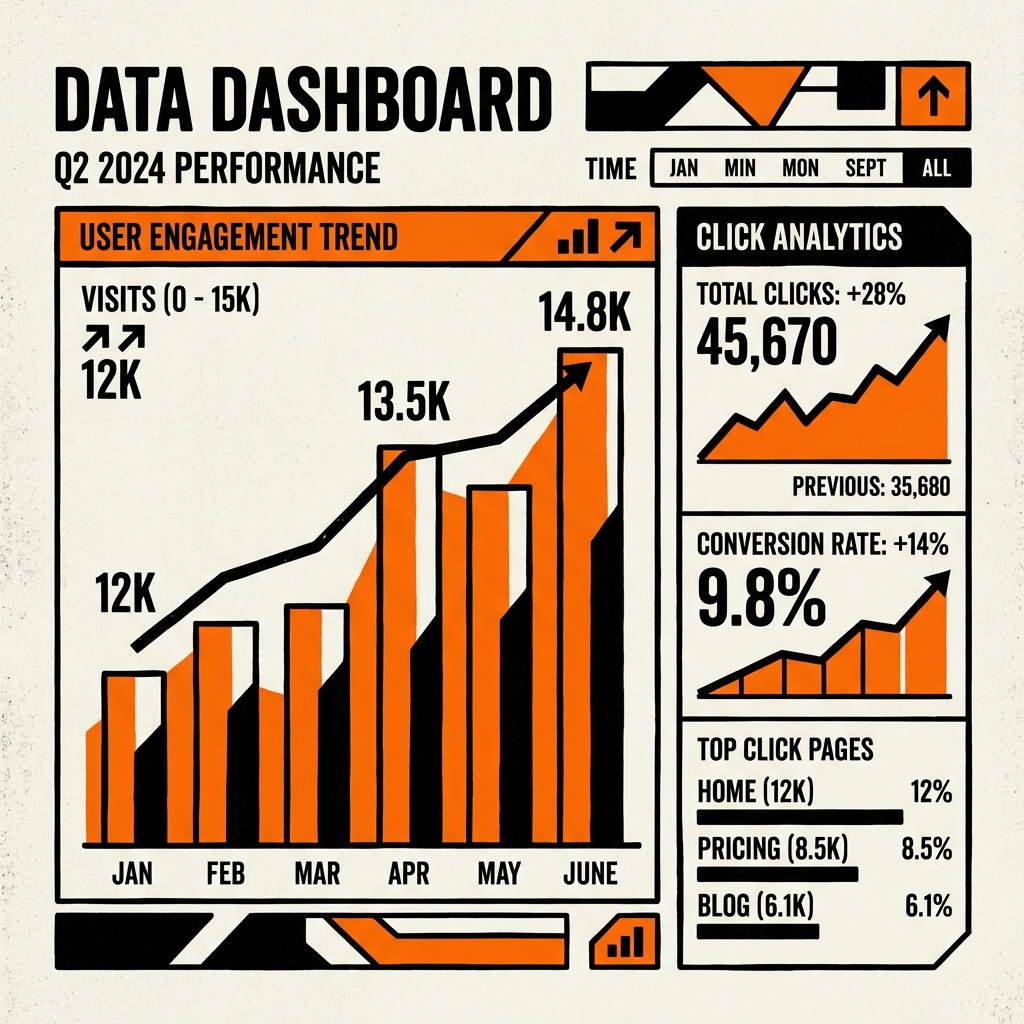
The Anatomy of a Click Event
When a short link is accessed, the URL shortening server logs the HTTP request. This raw log entry constitutes one click. It records the timestamp, the referring URL (if available), the user agent string, and the IP address. However, a single human user can generate multiple clicks in rapid succession. They might click a link, accidentally close the tab, and click it again seconds later. In a raw click tally, this behavior registers as two distinct interactions. Furthermore, shared networks, like corporate offices or public Wi-Fi hotspots, route hundreds of users through a single public IP address, complicating the identification process.
Advanced link analytics engines employ heuristic algorithms to deduplicate these raw requests. By assigning a short-lived session token or utilizing aggressive IP and User-Agent matching, the system calculates unique visitors. A standard benchmark in the industry suggests that for broadly distributed organic social media links, unique visitors typically account for only 60% to 70% of the total raw click volume. Analyzing the ratio between clicks and visitors provides insight into audience intent; a high click-to-visitor ratio often indicates extreme enthusiasm or a confusing landing page that necessitates multiple visits.
When evaluating campaign success, it is also essential to analyze the time-to-click metric. Automated systems typically scan a link within seconds of publication. In contrast, genuine human engagement follows a more organic curve, peaking during active browsing hours and tapering off naturally. Analyzing these temporal patterns helps marketers filter out sophisticated bot traffic that might otherwise evade standard User-Agent detection.
The Impact of Bots and Automated Scanners
The most significant source of click inflation comes from automated systems. When you post a link on a platform like Twitter, Slack, or Facebook, the platform's servers instantly fetch the URL to generate a rich preview card containing the meta title, description, and image. This server-side fetch registers as a click on the URL shortener. Additionally, search engine crawlers, cybersecurity scanners, and data scraping bots routinely traverse public links.
Robust analytics platforms differentiate between human browsers and known bot traffic by analyzing the User-Agent string and matching IPs against known datacenter blocks. For instance, a request declaring itself as Twitterbot/1.0 is clearly automated. While raw clicks are useful for auditing total network load, strategic marketing decisions must rely strictly on filtered unique visitor data to accurately calculate conversion rates and cost-per-acquisition (CPA).
Moreover, understanding the lifecycle of a unique visitor allows for more accurate conversion attribution. If a user clicks a short link on a Monday but does not convert until Thursday, the analytics platform must correctly stitch these sessions together using robust fingerprinting techniques. Failing to properly distinguish between redundant clicks and genuine returning visitors results in miscalculated Customer Acquisition Costs (CAC), ultimately leading to inefficient allocation of future marketing budgets.
Real Example / In Practice
A community manager distributes a monthly newsletter containing a promotional link: brnk.in/june-promo. Within ten minutes, the analytics dashboard shows 1,500 total clicks. However, the email was only sent to 800 subscribers.
Upon reviewing the filtered data, the manager sees 450 unique visitors and 1,050 automated clicks. The massive discrepancy is traced back to enterprise email security gateways—automated firewalls that proactively scan every link in an incoming email to detect phishing attempts before delivering the message to the employee's inbox. By focusing on the 450 unique visitors rather than the raw 1,500 clicks, the marketing team calculates a realistic 56% open-to-click rate.
Authoritative Measurement Standards
To deepen your understanding of web traffic measurement standards, consult the guidelines published by the W3C on web log analysis. Furthermore, definitions and industry standards regarding audience reach and digital attribution are rigorously maintained and reported by global research firms such as Statista.
Related Articles

brnk Team
The brnk team builds and writes about web tools, link management, and digital productivity. brnk.in is a free URL shortener and QR code generator used by marketers, developers, and content creators worldwide. Learn more about us.